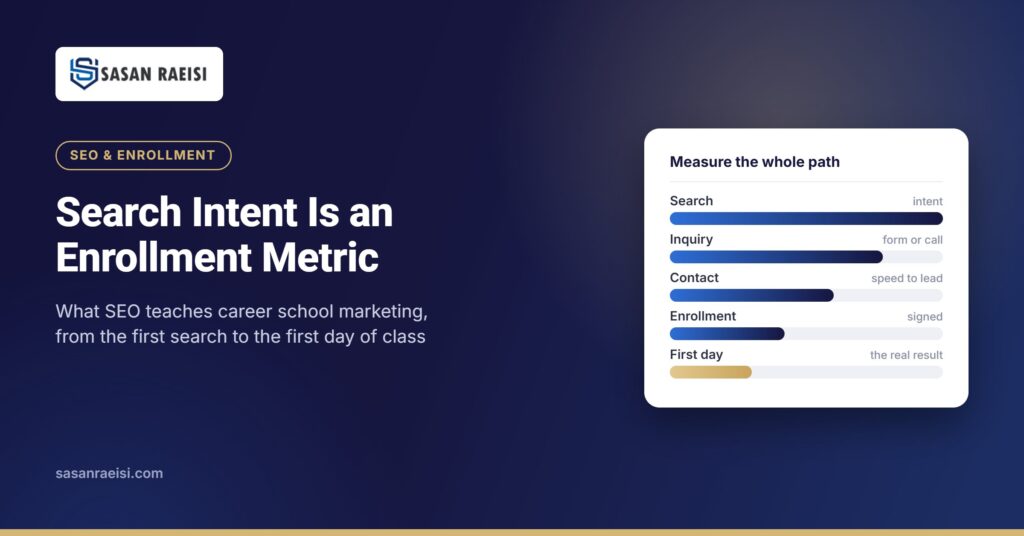
For most of my career, SEO reports have ended in the same place: rankings, traffic, and conversions. A conversion usually means a form fill or a phone call. For an online store that works, because the conversion is the sale. For a career school, a form fill is only the beginning. The real result happens weeks later, when a student walks into class on the first day.
That gap between the search result and the first day of class is where many school marketing budgets go wrong. It is also where SEO, done properly, has an advantage that most reports never show.
Search intent shows up again in the enrollment numbers
In SEO we talk about intent all the time. Someone searching “what does a medical assistant do” is learning. Someone searching “medical assistant program near me evening classes” is shopping. The second person has already decided on a career, a location, and a schedule. They are looking for a school.
That difference does not disappear after the form is submitted. A student who found you through a specific program search usually answers the phone, books the tour, and shows up. A student who tapped an ad while scrolling may never have meant to inquire at all. Both count as one lead in a standard report, but they are worth very different amounts.
This is why I encourage schools to stop judging channels by how cheap their leads are. A campaign that produces twice as many inquiries at half the price can still produce fewer students. Enroll Strategy walks through a worked example of this in its article on cost per lead versus cost per start, and the pattern matches what I have seen in search data for years: high-intent sources look expensive at the top of the funnel and cheap at the bottom.
Good SEO can be undone by what happens after the click
Here is the other side. You can rank first for every program in your city and still lose the student. Ranking earns the inquiry. Everything after that depends on the school.
The most common failures are not technical. The first reply comes hours or days later. Inquiries from the website, ads, and phone calls land in different places, so some are never answered. Follow-up stops after one missed call. Questions about cost and schedule get vague answers. And after a student enrolls, nobody contacts them until the first day, so doubts grow. Enroll Strategy breaks these down in detail in why career schools lose students between the inquiry and the first day, with a practical fix for each one.
From an SEO point of view, this is painful to watch. The hardest and slowest part of the work, earning visibility for competitive program searches, is already done. Then the student slips away because a voicemail was not returned.
Measure from the search to the first day
The answer is to treat the whole path as one system and measure it that way. In practice, that means a few habits:
- Keep the source attached to the student. Tag campaign links with tracking parameters, and pass organic and referral sources into the admissions record or CRM. If the source stays in the analytics dashboard, nobody can connect it to a start later.
- Track landing pages, not just channels. Organic search is not one source. A program page that ranks for “LVN program in Los Angeles” and a blog post that ranks for “how long is nursing school” bring in very different students. Report on them separately.
- Count starts, not form fills. Use attendance on the first day, or after the first week, as the finish line. Report by program and start date, because school-wide averages hide where the problems are.
- Put speed to lead next to traffic. If organic inquiries grow while response time slips, the extra traffic will not turn into students. Both numbers belong in the same monthly review.
- Bring admissions into the conversation. Advisors often know which pages and campaigns bring serious students before the numbers prove it. Their notes are useful input for content and keyword decisions.
What this changes for SEO decisions
Once you can see starts by source and landing page, SEO priorities become much clearer. You stop chasing broad, high-volume informational keywords just because they bring traffic. You put more effort into program pages, location pages, and the questions students ask right before they choose a school: cost, schedule, financial aid, admission requirements, and how long the program takes.
Those pages also help the admissions team. When a program page already answers cost and schedule plainly, the first phone call starts further along, and fewer students drop off because they could not get a straight answer.
The same thinking applies to how AI search tools decide which businesses to recommend. Tools that recommend schools draw on pages that state facts clearly and consistently. A school whose website answers the real questions is easier for those tools to recommend, and easier for a student to choose.
The cheapest growth is often already in your funnel
Most schools I talk with want more leads. Sometimes that is the right goal. More often, the faster win is making sure the students who already searched, found the school, and raised their hand actually arrive on day one. Better rankings help most when the rest of the path is ready for the students they bring.
This is the work I focus on through Enroll Strategy, the enrollment marketing firm I founded for colleges, career schools, and healthcare training programs. If you want to see where your own path from search to first day is losing students, book a free strategy call with Enroll Strategy. Bring your current enrollment numbers, and we will look at where students are getting stuck.